Disonant Hues
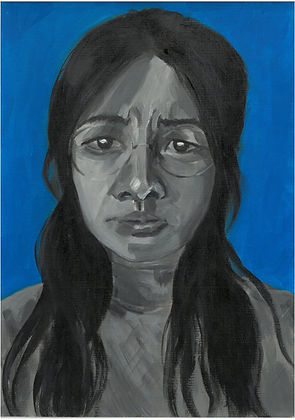
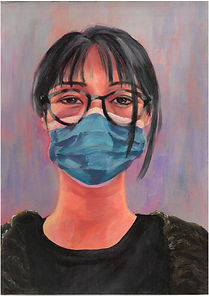
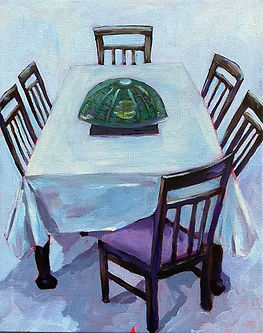
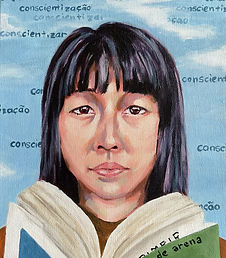
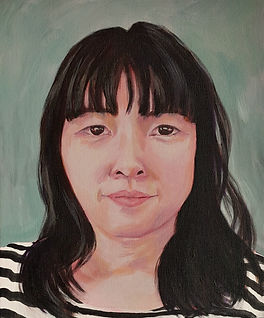
Disonant Hues is a series of autoethnographic paintings and poems that trace Yamamoto’s journey as a reflexive artistic researcher based in Australia. It engages with questions of positionality, power relations and how engaging in collaborative artistic praxis has shaped her own critical consciousness and ongoing commitment to socially engaged artistic practices.

My name is Emily...
My first primary school was in St Kilda,
made up of mostly white kids.
My English wasn’t good.
My sisters tried to protect me.
Emily,
was my first bully.
I chose my official name.
Emily,
but a better Emily
At my next primary school,
again, I was severely bullied,
bashed by other kids,
cornered in the toilets,
tied up with a skipping rope.
The teachers said they were just playing.
After school,
boys on bicycles circled me,
pulling their eyes,
they would say “Ching Chong”.
In our letterbox,
a note saying
“Go back home!”
Racism has changed
People don’t say “Ching Chong” anymore.
People don’t say “Go back to your own country” out loud anymore.
The eye pulling happens only now and then.
But today,
I am being called “Nicole”,
then nameless
because all Asians look the same,
right?
My name is Emily,
and I don’t think you understand who I am.
Conscientização
Conscientização
To understand the self
and how I fit into oppressive systems.
It takes reflection
on my privilege
my power
my oppression.
Challenging my accepted beliefs,
I also notice the privilege of others,
their defensiveness.
My eyes open.
I am a non-white woman
in a white environment.
Racism
nasty remarks
pretending to speak Chinese and speaking gibberish instead
my place questioned
one minute invisible
the next, scanned by their eyes.
Learning conscientização
I understand anger and frustration
I remind myself of compassion and love.
Vehicles of power
Hosts of oppression
circulated
exercised
A person is complex
with many layers
with networks of relationships.
Not only an oppressed person.
Not only an oppressor.
I wear a mask
to shield myself from viruses,
from parasites.
But they surround me
in everything I touch,
in the air I breath.
It is a helpless situation.
A mask makes no positive change.
A shield does not prevent me
from circulating and exercising oppressive power.
Making critical decisions
even if its against hegemonic ways
is more useful.
I might not get it right
but it’s better than blindly following norms
and hurting people along the way.
I chatted with my dad at the dinner table last night.
He visited his hometown this year,
saw his brother, sister and family.
They visited their old home,
mostly in ruins,
walls,
stained by memories.
“Why was your family forced out of your own home?”
His childhood family had money, he explained.
He became quiet.
That place carries memories,
many of them sad ones.
He remembers,
they made his mother knell on glass,
her hands
behind her back
tied to a tree.
That tree is not there anymore.
We sat in silence,
both teary and red eyed.
We step away from the table.
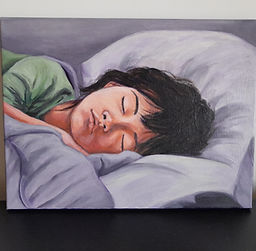
I am awake,
watching my daughter sleep
She helps me make sense of “resting as resistance”
It is mutual love and care
in a cruel and uncompassionate world
It takes effort
an intentional act
to stop and rest,
to resist
against capitalism, patriarchy, and grind culture.
What is rest?
I do not sleep well.
Instead, in the process of marking art,
I rest and heal,
recharging my soul,
enriching my imagination.
I found words and concepts
others explained well.
I use their words.
It is a burden off my shoulder
as a person not good with words.
In turn,
I present myself as arrogant,
to cover my insecurities and shame,
talking about things
that people cannot understand.
If I am serious about conscientização,
I should communicate
in a way that is accessible,
honouring the knowledge and lived experiences
of the people I speak with,
connecting to their world.
I am in awe
with all the people I got to meet,
the rooms I got to enter,
the voices I got to hear,
the eyes I got to look into,
the hands I got to shake,
the insecurities I got to feel,
the walls I learned to fear,
the stories I got to listen to.
Without the arts,
all these senses and experiences would be missing.
Hope,
I am coming to understand
is hard work.
There is pain in it,
yet, I am full
knowing I am doing my part
with the little I have.