Songs of the Oppressed
The show, Opinião,
came to respond
to the anxiety of the people
regarding the injustices of a class society.
---
O teatro Opinião,
veio responder
as ansiedades da gente
no que se relaciona as injustiças de uma sociedade classe.
(Found poem based on interview, 2023)
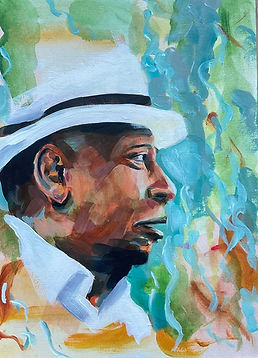
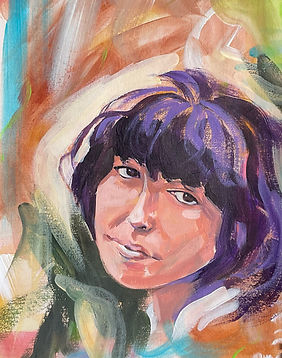
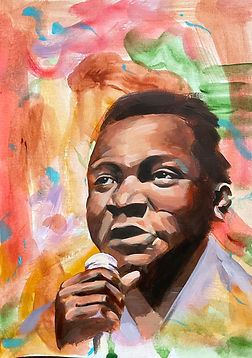
OPINIÃO 1964
Opinião is considered one of the first cultural acts in 1964, which premiered only months after the military coup in Brazil, a dictatorship that lasted twenty-one years (1964-1985). It was a rehearsal for the artists in opposition of the regime to test how far they could go. Grupo Opinião and Augusto Boal's Arena Theatre of São Paulo pushed the boundaries of traditional theatre by mixing the languages of music and theatre. They blurred the line between the actor and spectator, where the artists performed in everyday clothes in a raw theatre without a raised stage. Dialogue between actors and spectators was common in the show. The artists of Opinião and the protest art movement aimed to mobilise their audiences through art that centres the lived experiences of the common people of Brazil - "o povo".
The three main singers, Zé Keti, Nara Leão, and João do Vale (from left to right in paintings above) represented the lived experiences of three social layers: the Black working class from the favelas, a young socially engaged artist from the affluent south zone of Rio and a Black immigrant from the rural north of Brazil. The show is a patchwork of their testimonies and music, exposing sociopolitical injustices of the time.
COLLABORATIVE ARTISTIC PRAXIS & SONGS OF THE OPPRESSED
Opinião emerged from a collaborative artistic process that offers insights into how we can engage in artivism and artistic research today. The foundation of the show is the lived experiences of the artists from three social layers in Rio de Janeiro (a Black man from the favelas, a Black internal migrant from the rural northeast of Brazil, and a White socially-engaged woman). Based on the interviews of the three artists, the show patchworked the fragments of their testimonies with popular music and theatre to activate the audience.
Inspired by this process that centres the lived experience of 'o povo' - the common people, Yamamoto designed an artistic methodology that involves dialogue and reflection (Freire 1970), found poetry (Patrick 2016), collaborative music exploration and visual interpretation. You can read more about this in Songs of Solidarity.
In 2023, Yamamoto interviewed academics and artists in Brazil about themes surrounding Opinião. Interviews are analysed through found poetry that illuminates diverse perspectives on the sociopolitical landscape in which Opinião was born.
We
carry within us
a figure of the oppressor,
oppressor
inside of me.
The ideology
has this role of making me take what is the truth
the truth of another class.
We
are hosts.
We
like an illness.
We
host a virus and
it feeds like that.
We
end up working for them.
Nós
carregamos dentro de nós
essa figura do opressor,
opressor
dentro de mim.
A ideologia
tem esse papel de fazer com que eu tome como uma verdade
a verdade de uma outra classe.
Nós
somos hospedeiros.
Nós
como se fosse uma doença.
A gente
hospeda um vírus e
ele se alimenta desse jeito.
A gente
acaba trabalhando para eles.
Zé Keti,
in samba of the hill.
The hill,
is not geographically marginalised,
it is inserted in the middle of the city.
This music,
it is impregnated
with a European romantic harmony.
João do Vale,
music of the northeast, rural
another aesthetic,
another thematic,
that sings other pains,
singing the misery,
but is another misery,
very different from the misery of those who live in the city of Rio de Janeiro.
A Nara,
a white middle-class girl who sang bossa nova,
starts looking at this universe and says,
“Hey, there is more out there.
There is a whole world.”
Beyond the bourgeois bossa nova.
Zé Keti,
num samba do morro.
O morro,
não é marginalizada geográfico,
ele está inserida no meio da cidade.
Essa música,
ela está impregnada
de uma harmonia romântica européia.
João do Vale,
música do nordeste, rural,
uma outra estética,
uma outra temática,
que canta outra dores,
cantando a miséria,
mas são outras misérias,
muito diferent da miséria de quem mora na cidade do Rio de Janeiro.
A Nara,
uma menina branca de classe méia que cantava bossa nova,
começa a olhar para esse universo e fala,
“Opa, tem mais coisa aí.
Tem um mundo inteiro.”
Além daquela burguesa da bossa nova.
The song introjects in the people.
It has the power of internalization in each person.
Sometimes,
something that happens now that you release,
will pass slowly,
suddenly
it explodes further ahead.
A canção introjeta nas pessoas.
Ela tem o poder de internalização em cada um.
Às vezes,
uma coisa que acontece agora e que você lança,
vai passando devagar,
de repente
explode mais adiante.
DIP,
the department of the press and propaganda,
the censorship watched with the greatest care.
Why?
It was music that could produce something with the opposite meaning,
instead of praising the regime and the government,
suddenly, they could put forward an idea,
many were censored for this.
DIP,
departamento de imprensa e propaganda,
a censura olhava com o maior cuidade.
Por que?
Eram as músicas que podia produzir alguma coisa de sentido contrário,
em vez de se exaltar o regime e o governo
de repente podia botar uma ideia
e muitos foram censuradas por isso.